workshop
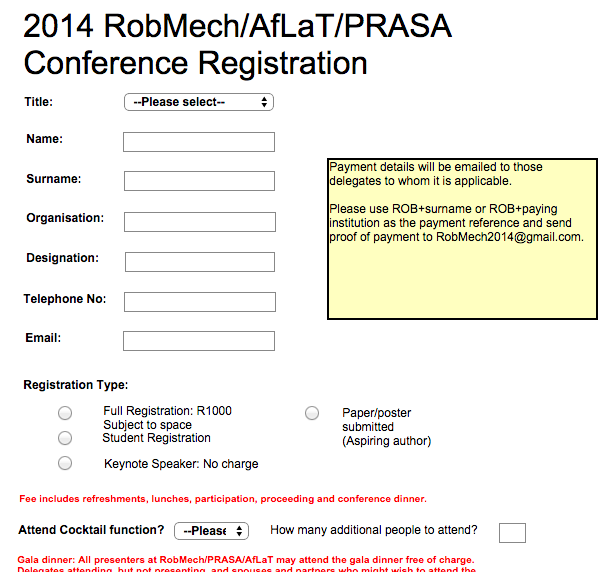
2014 RobMech/PRASA/AfLaT Conference Registration is now open!
Submitted by Guy on Mon, 2014-10-13 13:39You can register your participation on
- Login to post comments
PRASA/AfLaT/RobMech - First call for Papers
Submitted by Guy on Thu, 2014-08-28 14:31Submission deadline extended until 29/9!!!
FIRST CALL FOR PAPERS For the Joint conference of
25th annual symposium of the Pattern Recognition Association of South Africa (PRASA)
6th Workshop on African Language Technology (AfLaT)
7th conference of Robotics and Mechatronics (RobMech)
in Cape Town on
27 and 28 November 2014
The 25th annual symposium of the Pattern Recognition Association of South Africa (PRASA) will be held in conjunction with the 6th Workshop on African Language Technology (AfLaT) and the 7th conference of Robotics and Mechatronics (RobMech) on 27 and 28 November 2014 at the Lagoon Beach Hotel in Cape Town (https://www.lagoonbeachhotel.co.za).
Program - AfLaT2012/SALTMIL joint workshop on Language technology for normalisation of less-resourced languages
Submitted by Guy on Mon, 2012-04-16 14:16Tuesday, 22 May 2012.
Lütfi Kirdar Istanbul Exhibition and Congress Centre, Istanbul, Turkey
[register here]
09:30–10:30 | Invited Talk - How to build language technology resources for the next 100 years Sjur Moshagen Nørstebø, Sámi Parliament |
|---|---|
10:30–11:00 | Coffee Break |
| 11:00–13:00 | Resource Creation |
| 11:00–11:30 | Issues in Designing a Spoken Corpus of Irish Elaine Uí Dhonnchadha, Alessio Frenda and Brian Vaughan |
| 11:30–12:00 | Learning Morphological Rules for Amharic Verbs Using Inductive Logic Programming Wondwossen Mulugeta and Michael Gasser |
| 12:00–12:30 | The Database of Modern Icelandic Inflection Kristín Bjarnadóttir |
| 12:30–13:00 | Natural Language Processing for Amazigh Language: Challenges and Future Directions Fadoua Ataa Allah and Siham Boulaknadel |
13:00–14:00 | Lunch Break |
| 14:00–16:00 | Resource Use |
| 14:00–14:30 | Compiling Apertium morphological dictionaries with HFST and using them in HFST applications Tommi A. Pirinen and Francis M. Tyers |
| 14:30–15:00 | Automatic structuring and correction suggestion system for Hungarian clinical records Borbála Siklósi, György Orosz, Attila Novák and Gábor Prószéky |
| 15:00–15:30 | Constraint Grammar based Correction of Grammatical Errors for North Sámi Linda Wiechetek |
| 15:30–16:00 | Toward a Rule-Based System for English-Amharic Translation Michael Gasser |
16:00–16:30 | Coffee Break |
| 16:30–17:30 | Poster Session |
| | • Technological Tools for Dictionary and Corpora Building for Minority Languages: Example of the French-based Creoles – Paola Carrion Gonzalez and Emmanuel Cartier • Describing Morphologically-rich Languages using Metagrammars: a Look at Verbs in Ikota – Denys Duchier, Brunelle Magnana Ekoukou, Yannick Parmentier, Simon Petitjean and Emannuel Schang • A Corpus of Santome – Tjerk Hagemeijer, Iris Hendrickx, Abigail Tiny and Haldane Amaro • The Tagged Icelandic Corpus (MM) – Sigrún Helgadóttir, Ásta Svavarsdóttir, Eiríkur Rögnvaldsson, Kristín Bjarnadóttir and Hrafn Loftsson • Semi-automated extraction of morphological grammars for Nguni with special reference to Southern Ndebele – Laurette Pretorius and Sonja Bosch • Tagging and Verifying an Amharic News Corpus – Björn Gambäck • Resource-Light Bantu Part-of-Speech Tagging – Guy De Pauw, Gilles-Maurice de Schryver and Janneke van de Loo • POS Annotated 50M Corpus of Tajik Language – Gulshan Dovudov, Vít Suchomel and Pavel Šmerk |
17:30–17:45 | Closing Session |
- Login to post comments
AfLaT 2013 (at GAPSYM 2013), Ghent - 6 December 2013
Submitted by Guy on Wed, 2013-09-18 12:03We are happy to announce that this year’s workshop dealing with African Language Technology (AfLaT) will take place on Friday 6 December 2013, at Ghent University. This year’s workshop, the fifth in the series, is conceived differently from the earlier ones, in that we wish to broaden our activities by reaching out to all colleagues who have lexical resources for the African languages, and already work with those resources, but have not yet necessarily made the move to using advanced computational routines to speed up the analysis or the building of tools. In other words, are you a corpus linguist working on the African languages, and would you like to know how computational linguistics could further your work, then this workshop is for you. Or, do you have African language data (corpora), and would you like to know about the state-of-the-art software tools to annotate and search those data, then this workshop is for you. Of course, if you are already into computational linguistics for the African languages, then you are most welcome to present your latest research results.
This year’s workshop, then, is conceived as a MasterClass, led by the founding members of AfLaT: Guy De Pauw (U Antwerp), Gilles-Maurice de Schryver (U Ghent), and Peter Wagacha (U Nairobi). We welcome all researches currently working with African-language corpus data, inviting them to present their current data sets and/or research during max. 20 minutes, to be followed by a discussion and advice from those present for 10 min. Working languages are English and French.
To participate we will need a title for your talk, and a brief abstract only, to be sent to the local organiser, G-M de Schryver (details below), no later than 15 November 2013.
PRACTICAL MATTERS of AfLaT 2013
As we CO-LOCATE with the GAP Symposium, we ask all participants to register online at: https://www.gap.ugent.be/registration. The REGISTRATION FEE is symbolic, at just 10 EUR for BA and MA students, 20 EUR for PhD students, 50 EUR for all others, and includes the conference folder, teas and coffees during the breaks, as well as a light lunch. (Those who wish to present their paper as a poster during the GAP lunch are also welcome to do so in addition.)
For tips on TRAVEL to the venue, please see: https://www.gap.ugent.be/GAPSYM7_entravel
For tips on ACCOMMODATION, please see: https://www.gap.ugent.be/gapsym7_enaccommodation
For all further information, either contact the AfLaT organiser, and/or see: https://www.gap.ugent.be/gapsym7_eninfo
MORE INFO on AfLaT
WEBSITE: https://aflat.org
WORKSHOP SERIES
o 1st, AfLaT 2009: Athens, Greece (@ EACL 2009)
o 2nd, AfLaT 2010: Valletta, Malta (@ LREC 2010)
o 3rd, AfLaT 2011: Addis Ababa, Ethiopia (@ AGIS 2011)
o 4th, AfLaT 2012: Istanbul, Turkey (@ LREC 2012)
o 5th, AfLat 2013: Ghent, Belgium (@ GAPSYM 2013)
SPECIAL ISSUE of the journal Language Resources & Evaluation on AFRICAN LANGUAGE TECHNOLOGY: https://aflat.org/content/language-resources-evaluation-special-issue-african-language-technology
We hope to receive your submissions soon!
Gilles-Maurice de Schryver
KongoKing Research Group
Department of Languages and Cultures
Ghent University
Rozier 44
B-9000 Ghent (Belgium)
E-mail: gillesmaurice [dot] deschryver [at] ugent [dot] be
- Login to post comments
DEADLINE EXTENDED! Call for Papers: Workshop on Language technology for normalisation of less-resourced languages (AfLaT2012/SALTMIL)
Submitted by Guy on Tue, 2011-12-20 08:19The 8th International Workshop of the ISCA Special Interest Group on Speech and Language Technology for Minority Languages (SALTMIL, https://ixa2.si.ehu.es/saltmil) and the 4th Workshop on African Language Technology (AfLaT2012) will be held as a joint effort in Istanbul, in May 2012, as part of the 2012 International Language Resources and Evaluation Conference (LREC 2012). This workshop will take place on Tuesday, 22 May 2012 in the Lütfi Kirdar Istanbul Exhibition and Congress Centre, Istanbul, Turkey.
Papers are invited for the above full-day workshop, in the format outlined below. Most submitted papers will be presented in poster form, though some authors may be invited to present in lecture format.
CALL FOR PAPERS: SLTU'2012 (DEADLINE EXTENSION)
Submitted by Guy on Thu, 2011-12-08 06:35The third International Workshop on Spoken Language Technologies for Under-resourced languages (SLTU’12) will be held near Cape Town, South Africa on 7-9 May 2012.
The workshop will focus on spoken language processing for under-resourced languages and aims at gathering researchers working on:
ASR, synthesis and translation for under-resourced languages
Portability issues
Multilingual spoken language processing
Fast resource acquisition (speech, text, lexicons, parallel corpora)
Applications of spoken language technologies for under-resourced languages
Other related topics
Original research papers in any of these areas are hereby invited – details are available at
https://www.mica.edu.vn/sltu2012/.
Previous Workshops on Spoken Language Technologies for Under-Resourced Languages were held in 2008 at the Hanoi University of Technology, Hanoi, Vietnam (see https://www.mica.edu.vn/sltu2012/) and in 2010 at University Sains Malaysia (USM), Penang, Malaysia (https://www.mica.edu.vn/sltu2012/). SLTU’12 will continue the tradition of providing a forum for the presentation of research results related to under-resourced languages. For SLTU’12, the languages of Africa will receive particular attention, but papers on all under-resourced languages are invited.
Students are encouraged to participate in SLTU’12 – financial support for such participation is being sought, and will be announced on the workshop Web site.
Important dates :
Paper submission: 13 Jan 2012 27 Jan 2012
Notification of Paper Acceptance: 7 Feb 2012 21 Feb 2012
Camera ready papers due: 28 Feb 2012 14 Mar 2012
Author Registration Deadline: 28 Feb 2012 14 Mar 2012
- Login to post comments
AfLaT2011 - AGIS'11 (deadline extension)
Submitted by Guy on Thu, 2011-09-15 12:49After two successful workshops in Athens, Greece (EACL2009) and Malta (LREC2010), we are very pleased to announce that the 2011 edition of the AfLaT workshop will be held as a breakout session of the AGIS’11 conference (Action Week for Global Information Sharing). It marks the first time an AfLaT workshop is organized on the African continent, namely in Addis Ababa (Ethiopia) on 1 and 2 December 2011.
The format will be a bit different from previous events. People interested in actively participating in AGIS’11 are asked to submit a proposal for a talk before 21 October 2011 (extended deadline) through the AGIS’11 website. This means that you will not need to submit a full paper before the conference. After the conference, we will send out a call for papers for an AGIS’11 or AfLaT2011-specific proceedings.
For the AfLaT2011 breakout session, we invite submissions on any topic related to language and speech technology and African languages including, but not limited to, the following:
- Corpora and corpus annotation
- Machine readable lexicons
- Morphological analyzers and spelling checkers
- Part of speech taggers and parsers
- Speech recognition and synthesis
- Applications such as machine translation, information extraction, information retrieval, computer-assisted language learning and question answering
- The role of language technologies in economic development, education, healthcare, and emergency and public services
- Documentation of endangered languages and the use of language technologies to enhance language vitality
- The combination of language and speech technology with mobile phone technology.
We hope to see you in Addis in December and look forward to receiving the proposals of your talks.
More information on AGIS’11 can be found in the press release (see below) or at https://www.agis11.org.
For specific AfLaT2011 information, please consult AfLaT.org or contact us at aflat2011 [at] aflat [dot] org.
- Login to post comments
Call for Participation - AfLaT 2010
Submitted by Guy on Mon, 2010-05-03 08:06The Second workshop on African Language Technology (AfLaT 2010) will take place in the context of the LREC2010 conference in Valletta, Malta. The AfLaT workshop provides a forum for researchers in the field of African Language Technology to meet and share the latest developments in their field. The workshop will kick off with an invited speaker, followed by refereed research papers in human language technologies.
Date: Tuesday, May 18, 2010
Location: Valletta, Malta
| 9:00 | 9:05 | Opening| 9:05 | 10:00 | Justus Roux | Invited Talk - Do we need linguistic knowledge for speech technology applications in African languages? 10:00 | 10:30 | Aditi Sharma Grover, Gerhard B. van Huyssteen and Marthinus W. Pretorius | An HLT profile of the official South African languages 10:30 | 11:00 | coffee break | 11:00 | 11:30 | Piotr Banski and Beata Wójtowicz | Open-Content Text Corpus for African languages 11:30 | 12:00 | Guy De Pauw, Naomi Maajabu and Peter Wagacha | A Knowledge-Light Approach to Luo Machine Translation and Part-of-Speech Tagging 12:00 | 12:30 | Rushin Shah, Bo Lin, Anatole Gershman and Robert Frederking | SYNERGY: A Named Entity Recognition System for Resource-scarce Languages such as Swahili using Online Machine Translation 12:30 | 13:00 | Hendrik J. Groenewald and Liza du Plooy | Processing Parallel Text Corpora for Three South African Language Pairs in the Autshumato Project 13:00 | 14:30 | lunch | 14:30 | 15:00 | Ronell Van der Merwe, Laurette Pretorius and Sonja Bosch | Towards the Implementation of a Refined Data Model for a Zulu Machine-Readable Lexicon 15:00 | 15:30 | Gertrud Faaß | The verbal phrase of Northern Sotho: A morpho-syntactic perspective 15:30 | 16:00 | Martha Yifiru Tachbelie and Wolfgang Menzel | Capturing Word-level Dependencies in Morpheme-based Language Modeling 16:00 | 16:30 | coffee break | 16:30 | 17:00 | Nicolas Laurens Oosthuizen, Martin Johannes Puttkammer and Martin Schlemmer | Improving Orthographic Transcriptions of Speech Corpora 17:00 | 17:30 | Artem Davydov | Towards The Manding Corpus: Texts Selection Principles and Metatext Markup | ||||
- Login to post comments
AfLaT 2010 - Preliminary Program
Submitted by Guy on Tue, 2010-04-06 09:11Date: Tuesday, May 18, 2010
Location: Valletta, Malta
| 9:00 | 9:05 | Opening| 9:05 | 10:00 | Justus Roux | Invited Talk - Do we need linguistic knowledge for speech technology applications in African languages? 10:00 | 10:30 | Aditi Sharma Grover, Gerhard B. van Huyssteen and Marthinus W. Pretorius | An HLT profile of the official South African languages 10:30 | 11:00 | coffee break | 11:00 | 11:30 | Piotr Banski and Beata Wójtowicz | Open-Content Text Corpus for African languages 11:30 | 12:00 | Guy De Pauw, Naomi Maajabu and Peter Wagacha | A Knowledge-Light Approach to Luo Machine Translation and Part-of-Speech Tagging 12:00 | 12:30 | Rushin Shah, Bo Lin, Anatole Gershman and Robert Frederking | SYNERGY: A Named Entity Recognition System for Resource-scarce Languages such as Swahili using Online Machine Translation 12:30 | 13:00 | Hendrik J. Groenewald and Liza du Plooy | Processing Parallel Text Corpora for Three South African Language Pairs in the Autshumato Project 13:00 | 14:30 | lunch | 14:30 | 15:00 | Kamau Chege, Peter Wagacha, Guy De Pauw, Lawrence Muchemi, Wanjiku Ng'ang'a, Kenneth Ngure and Jayne Mutiga | Developing an Open source spell checker for Gikuyu 15:00 | 15:30 | Gertrud Faaß | The verbal phrase of Northern Sotho: A morpho-syntactic perspective 15:30 | 16:00 | Martha Yifiru Tachbelie and Wolfgang Menzel | Capturing Word-level Dependencies in Morpheme-based Language Modeling 16:00 | 16:30 | coffee break | 16:30 | 17:00 | Ronell Van der Merwe, Laurette Pretorius and Sonja Bosch | Towards the Implementation of a Refined Data Model for a Zulu Machine-Readable Lexicon 17:00 | 17:30 | Nicolas Laurens Oosthuizen, Martin Johannes Puttkammer and Martin Schlemmer | Improving Orthographic Transcriptions of Speech Corpora 17:30 | 18:00 | Artem Davydov | Towards The Manding Corpus: Texts Selection Principles and Metatext Markup 18:00 | 18:30 | Wanjiku Ng'ang'a | Towards a Comprehensive, Machine-readable Dialectal Dictionary of Igbo 18:30 | 19:00 | Tristan Purvis | Corpus Building in a Predominantly Oral Culture: Notes on the Development of a Multi-Genre Tagged Corpus of Dagbani | ||||
- Login to post comments
AfLaT 2010 - Accepted Papers
Submitted by Guy on Tue, 2010-03-16 08:31We are pleased to announce that the following papers have been accepted for the 2nd workshop on African Language Technology. We are greatly indebted to the members of the program committee who have done an amazing job reviewing the papers.
- An HLT profile of the official South African languages - Aditi Sharma Grover, Gerhard B. van Huyssteen and Marthinus W. Pretorius
- Corpus Building in a Predominantly Oral Culture: Notes on the Development of a Multi-Genre Tagged Corpus of Dagbani - Tristan Purvis
- The verbal phrase of Northern Sotho: A morpho-syntactic perspective - Gertrud Faaß
- Open-Content Text Corpus for African languages - Piotr Banski and Beata Wójtowicz
- Developing an Open source spell checker for Gĩkũyũ - Kamau Chege, Peter Waiganjo, Guy De Pauw, Lawrence Muchemi, Wanjiku Ng'ang'a, Kenneth Ngure and Jayne Mutiga
- Towards the Implementation of a Refined Data Model for a Zulu Machine-Readable Lexicon - Ronell Van der Merwe, Laurette Pretorius and Sonja Bosch
- Gathering Parallel Text Corpora for Three South African Language Pairs in the Autshumato Project - Hendrik J. Groenewald and Liza du Plooy
- Capturing Word-level Dependencies in Morpheme-based Language Modeling - Martha Yifiru Tachbelie and Wolfgang Menzel
- Towards The Manding Corpus: Texts Selection Principles and Metatext Markup - Artem Davydov
- SYNERGY: A Named Entity Recognition System for Resource-scarce Languages such as Swahili using Online Machine Translation - Rushin Shah, Bo Lin, Anatole Gershman and Robert Frederking
- A Knowledge-Light Approach to Luo Machine Translation and Part-of-Speech Tagging - Guy De Pauw, Naomi Maajabu and Peter Wagacha
- Improving Orthographic Transcriptions of Speech Corpora - Nicolas Laurens Oosthuizen, Martin Johannes Puttkammer and Martin Schlemmer
- Towards a Comprehensive, Machine-readable Dialectal Dictionary of Igbo - Wanjiku Ng'ang'a
- Login to post comments